Q&A with Jacquie Pierri ’12
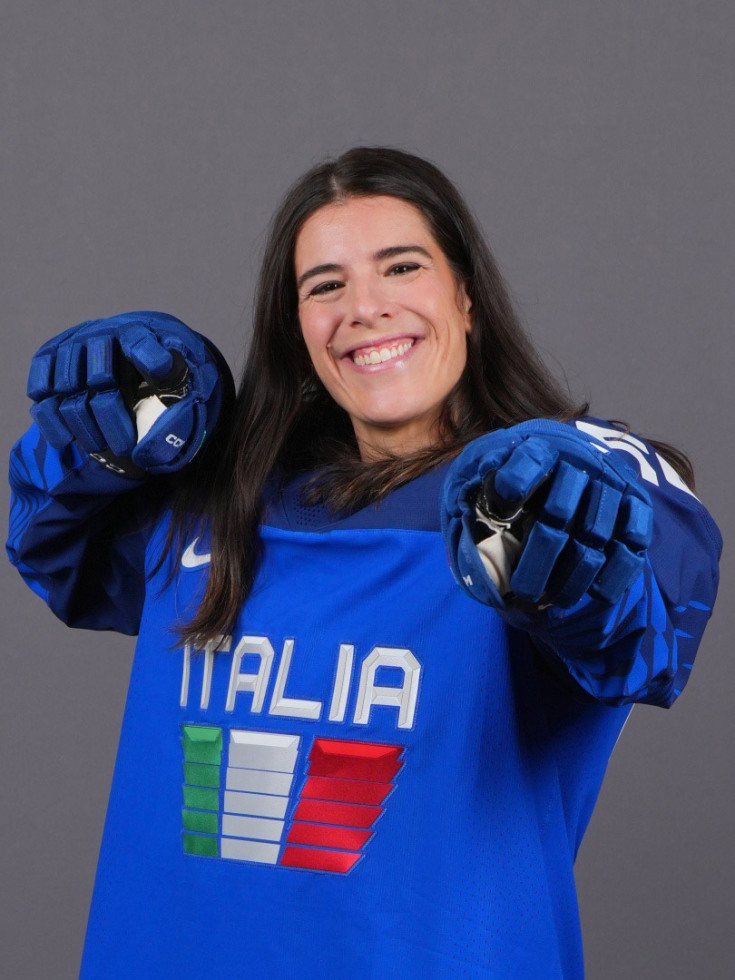
After graduating from Brown University with a focus on sustainable energy, Jacquie Pierri ’12 took her hockey talents to the global stage, competing for the host, Team Italy, in the 2026 Winter Olympics. As an engineer and EcoAthlete, she is leveraging her platform as a hockey player to champion climate change awareness and sustainable innovation in sports.
Q: What is your favorite memory from the Olympics?
It's hard to pick just one! Probably the top memory is seeing the joy on my family's faces and hugging them on the concourse after games. Also up there would be circling the ice, thanking the home crowd to the song, Sarà perché ti amo, after we historically qualified for the Quarterfinals. (There was also a 24/7 Focaccia bar at the Olympic Village!) 🙂
Q: What was your experience as a student-athlete at Brown?
Honestly, being a student-athlete at Brown, especially in engineering and ice hockey, was really challenging. When I look back at those years, I don't really understand how we managed (there was definitely sacrificed sleep). I remember feeling constantly behind, often missing group homework sessions or office hours because I had training. Thankfully, my teammate and roommate Jenna Dancewicz ’11 was going through it as well, and we could lean on each other. For any other student-athletes going through that now, I would just try to remember that school isn't a competition and you aren't running the same race as your classmates. Try to take what you personally need and want from your coursework without comparing the joy out of it.
Q: How did Brown’s curriculum cultivate your interest in sustainable energy?
I was very interested in sustainability and solutions to climate change coming out of high school. At the time, Brown Engineering didn't have a track that was perfectly aligned with sustainable energy, but it had a few courses, like Renewable Energy Technologies (with Professor Chris Bull) and some classes in other departments, like Sustainable Design in the Built Environment (with Professor Kurt Teichert). In retrospect, the greatest differentiator of Brown's curriculum, compared to my colleagues later in my career, is the interdisciplinary nature of the first two years. The broad base of knowledge was such an advantage because it allowed me to follow my curiosity with more credibility.
Energy problems rarely sit in one bucket. It's helpful to understand the technology, the policy, the economics, and even the human behavior aspect. We need people approaching the problem from every angle.
Q: Walk us through your career journey.
During college and immediately after graduation, I had internships with PSE&G (New Jersey’s Public Service Electric and Gas), contributing to the development and monitoring of a distributed solar PV program, and with RPM (Development Group) exploring ways to incorporate sustainability principles into affordable housing projects. Shortly after, I moved up to Calgary in Alberta, Canada, where I worked for ATCO Gas. I started out doing hydraulic modeling and forecasting of the natural gas pipeline network in the Province, which was a great introduction to so much of the hidden infrastructure that we take for granted in our day-to-day lives. I moved into Project Engineering and ultimately to the Sustainability Team, where we explored hydrogen blending, biogas, micro-combined heat and power with PV, and various other monitoring solutions such as leak detection technologies. I left Calgary to complete a dual-Master's program in Sustainable Energy Systems with one year in Barcelona and one in Stockholm. This program was a great blend of technology, entrepreneurship, and systems thinking. I completed my thesis on lower global warming potential and energy-consuming refrigerants for Ice Rinks, and after that, moved to Italy. I worked part-time at a startup that was capturing heat from local agricultural prunings to heat hot water for hotels. Simultaneously, I was working for the European partner of the US-based Living Future non-profit organization, which develops very ambitious regenerative building standards. With Living Future Europe, I was helping promote this standard for projects and educate professionals on the standards in Europe. While doing this, I played five seasons in the Canadian Women's Hockey League (CWHL), where we won a championship, two seasons in the Swedish Women's Hockey League (SDHL), and I am now in my fifth season in the European Women's Hockey League (EWHL).
Q: What do you do as an EcoAthlete?
EcoAthletes is an incredible community of people from the sports world who care about the problem of climate change. We have monthly speakers who talk about various topics. Sometimes they are fellow EcoAthletes, other times we have top researchers and climate advocates like Dr. Katharine Hayhoe and Dr. Allen Hershkowitz speak to us. I've also had the opportunity to speak at Sports@COP26, be interviewed on several podcasts (such as the Plant-Based Athlete), and take part in a not-yet-released documentary called The Last Game. This month, we have the Collegiate Cup going on - where every minute of exercise you log earns beach plastic clean up. It's open to everyone, we have a Brown University team going, and we can't let Cornell win again this year, right? (sign up on your mobile phone!)
Q: How do you connect your passion for playing hockey with your work in sustainability?
For me personally, hockey has been an indoor sport my whole life. However, I've seen the impacts of climate change significantly change the places I like to snowboard (where I live in the Alps, it's one of the fastest-warming places on the planet - the glaciers are reportedly unsalvageable at this point). Where I see the value in the connection between hockey and my work in sustainability is that sport connects you (deeply) with a different crowd. I often find that in sustainability, we are unintentionally preaching to the choir. I think it's a great opportunity to reach people of different backgrounds, who might not politically align with the concept of combating climate change, but through getting to know me, might be more open to understanding that the impacts are vast and cross political lines.
Q: What advice would you give those interested in a career focused on sustainable energy?
For students interested in sustainable energy, I would say follow your curiosity. Energy problems rarely sit in one bucket. It's helpful to understand the technology, the policy, the economics, and even the human behavior aspect. We need people approaching the problem from every angle. The second thing I would say is to get exposure to infrastructure and systems early. Working at electric and gas utilities gave me really helpful foundational knowledge. Developing and improving tech is really important, but I believe the bigger challenge is how they fit in the systems they operate in, both technically and within their regulation and economic schemes. That approach is critical to reaching scale and having a big impact.