When the School of Engineering at Brown posted a job description for a pioneering role at the intersection of human brain-computer interfaces, neural decoding, and translational rehabilitation, Indie Garwood felt as if it was written just for her.
She was completing her Ph.D. in the Health Sciences and Technology (HST) program run jointly by MIT and Harvard, finishing clinical internships alongside standard coursework. Following a postdoc position at Penn, she arrived at Brown in the fall of 2026.
Reflecting on the journey that led her to a second floor office in the Engineering Research Center, Garwood recalled the moment her passion for science first took root. “It was near the end of high school when it struck me how much freedom I could have in science. I realized all of the most fascinating things in the world to me were scientific,” she mused while thinking back on the many decisions that led her to this place.
“It was my uncle who suggested engineering. This was very practical of him – he was thinking about job opportunities. But it turns out he was very prescient in that way because I am an engineer. There are scientists and there are engineers. I approach problems in a very specific way, I’m very solution-oriented. My engineering training naturally puts me in that bucket.”
It started with an undergraduate degree in biomedical engineering from the University of Michigan, where she lived and worked in the Michigan Learning Community (“maybe the nerdiest dorms on campus,” she said, smiling), where she was immediately exposed to research and the world of lab work. This was a touchstone for her in the large university, and served to cement her commitment to BME. She landed in the lab of Professor Tim Bruns, seeing and assisting with research on the peripheral nervous system. “I wanted to do neuroscience, but you know, the way things work out when you’re an undergrad, you don’t always have a full choice,” Garwood said. “But research in the peripheral nervous system turns out now to be a rather hot topic, honestly, in the brain body connection. Looking back I am thankful to have that background and now be able to connect to the current state of the field.
“And, just because of how much I loved research, it was actually at Michigan that I heard about Ph.D. opportunities for the first time. My advisors in high school never really mentioned it. So I was exposed to it in freshman year and I remember going to a Q&A about MD Ph.D.s., and I thought maybe I wanted to do that.
“I was very interested in the medical side, the clinical side, which is why I was really drawn to the Ph.D. program that I ended up doing, HST at MIT and Harvard. The interesting thing about that program is the Ph.D. students take courses that are almost equivalent to the first year and a half of Harvard Medical School. And we did clinical internships where we worked on a team in the hospital. I got the taste of it. It almost convinced me,” she laughed.
For Garwood, the daughter of an interventional pain specialist and a practicing psychiatrist, it was the bog of the administrative side of healthcare that frustrated her. “In medicine, you do have the chance to just immediately touch somebody’s life and improve it,” she said. “And from an engineering, especially the academic perspective, I know it feels like it’s a long game we’re playing as far as medical conditions, but I really believe we can have lots of positive impact in other ways,” she said.
This impact is why she thinks Brown is the best place for her: A place where she can design intentional engineering solutions for complex neural systems. She will draw from her doctoral studies at MIT where she studied how anesthetics (specifically ketamine) alter large-scale brain activity and consciousness, while also continuing a focus on the neural probe materials used to monitor that. Optimizing stimulation parameters or closed-loop systems requires first solving the problem of large, rigid, non-biocompatible probes.
This is where the intentionality of her studies took its shape. As her co-adviser, Professor Emery Brown suggested she study anesthesia deeply for her doctoral thesis, and use that as a groundwork to her future. That side of the work is about inferring from brain activity the patient’s state of consciousness, focusing on how the intersection of neuroscience, engineering, and statistics can be leveraged to unravel mechanisms behind altered consciousness induced by high-dose ketamine. Moving to study lower dose ketamine will be one of her lab’s starting points, as it is a burgeoning treatment option for drug resistant depression.
In order to measure neurons’ activity, there must be implanted electrodes. “One of the areas of innovation that matters a lot is that all of those clinical electrodes are pretty large, on a scale of one to two millimeters, which might sound small. But that's a big piece of technology and it is rigid.”
That, she says, is one of the main reasons she was so connected to her other co-adviser Professor Polina Anikeeva’s lab. “I was also interested in brain stimulation. We really need to innovate on the materials first, because you can optimize the stimulation you’re delivering as much as you want, but if you’re putting in a big, non-biocompatible probe, this is still a big problem.” Anikeeva’s lab is making inroads to flexible materials - materials which match the softness of brain tissue (and spinal cord and peripheral organs) to minimize scarring. “So it felt like kind of jumping ahead to optimize stimulation parameters and develop closed loop stimulation. We need to focus on the materials. It’s all really important innovation.”
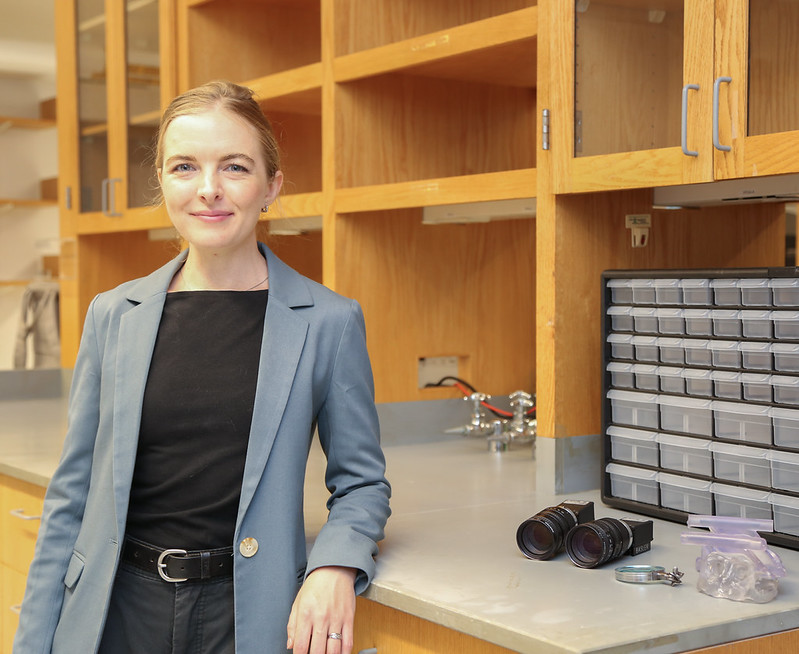 The Garwood Lab will host opportunities for students at all levels. “I’m thinking of it as two arms that will interact. There’s the kind of systems neuroscience aspect of things, which is definitely where Ph.D.s and postdocs will find their home, and then there’s the kind of more engineering side of the lab that’s going to work on new hardware, new analysis methods and the like. There will be Ph.D.s and postdocs who are on both sides, but undergrads in particular, I think, are going to have a ton to contribute to that more engineering arm of things. I’m really excited to work with undergrads because I’ve heard they’re just excellent here and really committed to research,” she said.