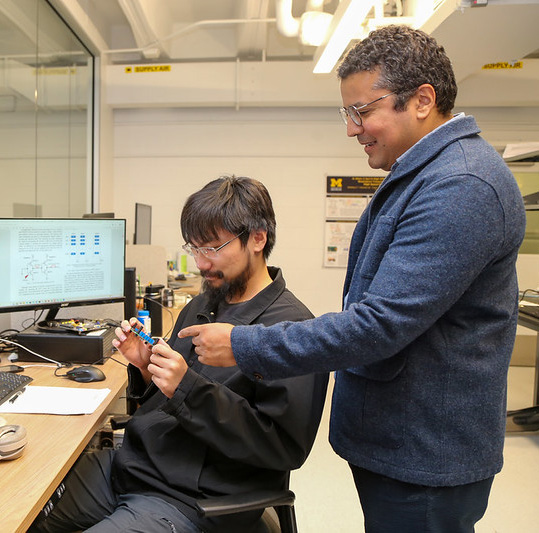
 The Defense Advanced Research Projects Agency (DARPA) has awarded up to $719,358 in research support over two years, with a conditional third year, to Brown University Assistant Professor of Engineering Mehdi Saligane, as part of its Young Faculty Awards program, now in its 20th year. Twenty-one researchers from the U.S. were selected in 2026, including Saligane and Brown Computer Science Associate Professor Malte Schwarzkopf.
Saligane’s “CMOS-Addressable DNA Random Access Memory” project aims to develop an entirely new kind of memory that uses biological DNA to store information and silicon chips to control how it is written and read, bridging molecular data storage and conventional electronics.
While current DNA data storage is slow and mainly used for long-term archiving, this project focuses on building random access memory (RAM) out of DNA. This means data can be quickly written, retrieved, modified, and erased on demand, just like the memory in a standard smartphone or laptop. Unlike standard digital memory, this hybrid system retains information without needing a continuous electricity supply. Additionally, because it uses robust biological molecules guided by scaled microchips, the memory is exceptionally durable, uniquely equipped to survive harsh conditions that would destroy traditional electronics, such as extreme cold and high levels of radiation found in deep space exploration.
For two decades, DARPA’s Young Faculty Award (YFA) program has been a catalyst for scientific and technological innovation. The program has supported over 500 rising research stars from more than 60 universities, driving breakthroughs aligned with national security areas of interest.
The YFA program identifies and engages early-career scientists at U.S. academic institutions, connecting these exceptional individuals to Department of War (DOW) needs and DARPA’s mission. Awardees are provided with critical funding, mentorship, and connections to industry and Department of War contacts. This ecosystem enables them to develop and frame their research ideas within the context of national security needs.
Associate Professor of Engineering David Borton was a recipient of the award in 2015.