Date
August 20, 2026
Seeing beyond the limits
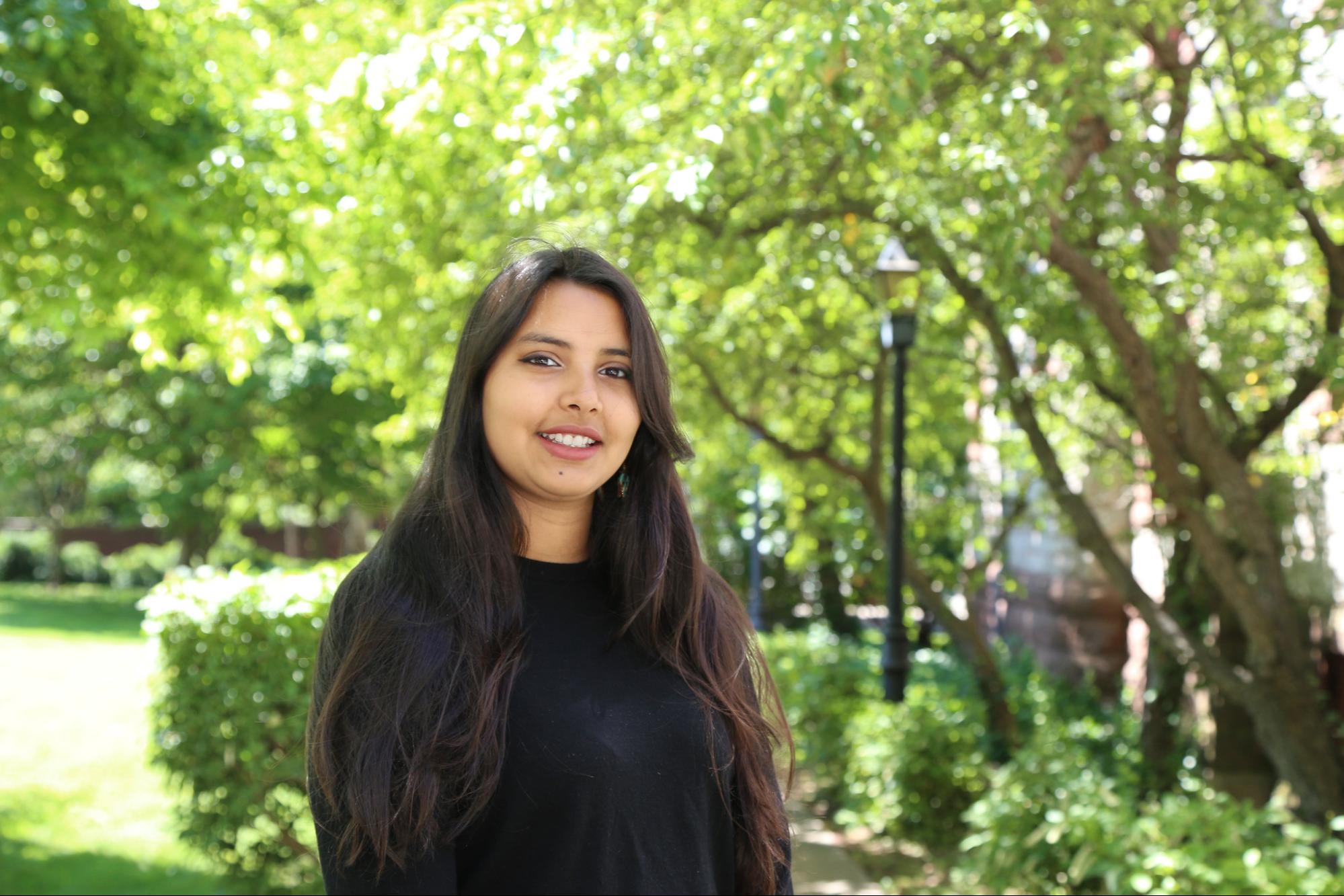
Lily Badiani-Shah Sc.M. ’26 seamlessly bridges creative design with strategic entrepreneurship, thriving in the fast-paced PRIME program by seizing competitive opportunities on a trajectory toward shaping the future of health tech.
From as far back as she can remember, Lily Badiani-Shah experienced vision issues, and learning to read was a struggle. She was fitted for glasses, then contacts, but the cycle would repeat. During this time, Lily was stumbling upon things that helped her. She found if something was printed on various colored paper or screens, the noise – or the continuous perception of tiny, flickering dots or static across the field of vision – was not as persistent. It takes nine years for the average diagnosis of Visual Snow Syndrome (VSS): the process is long and consists of many different tests, something then-15-year-old Lily learned after discovering she was in the very small percentage of humans who see flickering dots or flashing lights 24/7, whether the eyes are open or closed. The diagnosis is one of exclusion – there is no objective biomarker or single blood test to confirm VSS, so doctors must rule out all other potential eye and neurological conditions first.
Eight years later, Badiani-Shah came to the Innovation Management and Entrepreneurship (PRIME) program at Brown after completing her undergraduate studies in design at Central Saint Martins in London. Her rationale was fairly simple. In her final year as an undergraduate, she had created a prototype pair of glasses with colored lenses, an answer for VSS she thought she might advance. But she knew she needed to learn the business side of design. “That was the main reason I applied to PRIME, to gain more technical skills, business fluency, and to grow in my career,” she said. “I wanted access to this amazing faculty and staff, their experience and insight, and to use their knowledge.”
Brown’s PRIME program specifically bridges the gap between complex science/tech and commercial market viability, with graduates securing positions in consulting, investment banking, health/medical companies, information technology, traditional engineering companies, small technology firms and as founders of new ventures: The last one was foremost in Badiani-Shah’s mind. “But I realized early on that with manufacturing and shipping, onboarding different customers, this was going to cost a lot of money,” she said. “And what I really wanted was simply for a solution to be accessible to everyone.
“It was the first class with Professor (Hamzah) Ansari that made me realize this solution needed to have global accessibility, and needed to be digital.”
Leveraging the collaborative ecosystem Badiani-Shah immediately had immersed herself in, she wasted little time in connecting to the Visual Snow Initiative (VSI), the only non-profit organization created to establish global awareness, education, recognition, research and resources for VSS. She worked relentlessly to build Haunani (the Hawaiian word for ‘beautiful snow’), which is now featured on the VSI website.
“I thought this was a great way to give back to the community because a lot of people don’t have solutions out there, and all the solutions I used were for dyslexia. There was nothing visual snow specific. But all the dyslexic colors were too harsh on my eyes because of the contrast glare – I am so grateful the Visual Snow Initiative was willing to publish my site and even wrote a feature story on the whole thing.”
Badiani-Shah is quick to credit Brown and its preparation of students to step out of the classroom and immediately pursue meaningful opportunities. “I think learning here is great in that way. It lets you explore and so you can really choose your career path. I was really grateful to all the faculty, mentors and staff who had gone through all those processes, and encouraged and helped me reach out to people as well.
“I truly don’t think the collaboration with the Visual Snow Initiative would have happened without Brown because this network, and the opportunities here, opened doors I hadn’t imagined before.”
Ample opportunities came to Badiani-Shah throughout her time in the program. She joined an interdisciplinary RISD-led team competing in NASA’s Spacesuit User Interface Technologies for Students (SUITS) Challenge. The team (composed of Brown computer science master’s students, RISD product designers and industrial designers and Badiani-Shah) designed telemetry interfaces in Figma to support astronaut operations. Finishing in the top 10, team leaders took the design to NASA’s Johnson Space Center in Houston this summer, where the top teams demonstrated their solutions in the Rock Yard, a simulated lunar environment.
Badiani-Shah also took advantage of Brown’s cross-registration with Harvard, enrolling in the Harvard Kennedy School’s Science Power and Politics class during the year. The class is an exploration of how scientific knowledge and technical controversies intersect with state power, democratic citizenship, and global policymaking.
Another opportunity, this one from Shark-Ninja promoting its Jailbreak EDU, an intense two-day AI hackathon at their Needham office headquarters, caught her eye in May. Again competing with Brown master’s students in computer science and public affairs, as well as one undergraduate student, Badiani-Shah represented Brown Engineering by helping her team to a first place finish, building a working model from scratch.
“We had a mentor and project manager who worked with us on a brief we were given, and then they split the groups into teams of five, and in each team there was two software engineers to do the back-end, someone in marketing, a business professional, and then I came in more under product design,” she said, careful not to reveal any details from the non-disclosure agreement she had inked.
“Each team was given a different prompt to solve, and everyone was doing something completely different. We had the whole day to work on it before the next day when we practiced our pitches, and then presented.”
Badiani-Shah was especially grateful for the post-competition networking opportunities and enjoyed the challenge of a fast-paced event focused on AI. While previous projects like her Haunani site had already introduced her to Claude, she found the environment exhilarating. “To do it in such a short time frame and be able to see what we could produce under pressure was exciting,” she said.
Next on the list for the new graduate is to find employment in the health or accessibility field, and she plans to stay in the New England area to do so. “I want to go into design for healthcare solutions. I think Haunani is a great project that allowed me to bring everything I’ve learned together. It evolved from a physical prototype to a live digital platform that now reaches hundreds of users across VSI’s global community.
“You can go into different sorts of product design, but being able to make a difference in people’s lives is, I think, the best thing about that type of career.”