Assistant Professors Lucas Caretta and Peipei Zhou are among a group of early-career engineers recognized for exceptional research and technical work in a variety of disciplines, who will come together to facilitate cross-disciplinary exchange and promote the transfer of new techniques and approaches across fields in order to sustain and build U.S. innovative capacity. The 2026 U.S. Frontiers of Engineering Symposium will be held September 21-24 at the University of Texas, to explore four themes: Innovation in Bioengineered Materials; Compute Challenges for Artificial Intelligence; Precision Ag/State of Systems Engineering; and Hypersonics.
“Engineering has always been a force for progress, but its role is becoming even more vital as society faces increasingly complex and interconnected challenges,” said NAE President Tsu-Jae Liu. “The NAE aims to strengthen engineering leadership to benefit the nation and improve lives by advancing excellence, fostering collaboration across sectors and disciplines, and preparing engineers to lead with creativity, rigor, and purpose.
“The NAE’s Grainger Foundation Frontiers of Engineering Annual Symposium reflects the Academy’s commitment to elevating and connecting the next generation of engineering leaders,” Liu added. “By bringing together outstanding early career engineers from many disciplines, the symposium creates the kind of intellectually rich environment where new perspectives, professional networks, and future collaborations can take root.”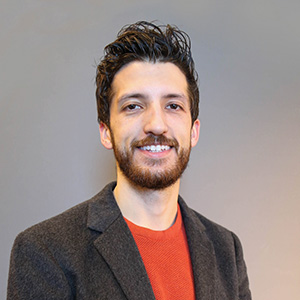 Caretta leads a research team at Brown that designs quantum materials at the atomic scale with tailored magnetic, electronic, and optical properties. His research approach uniquely combines epitaxial, atomic-scale thin-film synthesis with advanced in-situ characterization techniques, addressing fundamental nanoscale questions to overcome large-scale technological challenges. His work is situated at the intersection of fundamental oxide materials physics and innovative device applications. In 2025, he was awarded a Faculty Early Career Development (CAREER) grant from the National Science Foundation, enabling him to broaden the accessible materials palette for next-generation spintronic devices and enable new experimental approaches to controlling spin transport in a growing field that has a thirst for new materials approaches.
He came to Brown in the fall of 2022, after completing his postdoctoral studies in the Ramesh Lab at the University of California, Berkeley where he was a President’s Postdoctoral Fellow and a Ford Foundation Postdoctoral Fellow. He received his B.S. from the University of Minnesota and his Ph.D. in Materials Science and Engineering at the Massachusetts Institute of Technology as an National Science Foundation Graduate Student Fellow and GEM Consortium Fellow. He was awarded the 2024 International Union of Pure and Applied Physics (IUPAP) Early Career Scientist Prize in the field of Magnetism, and in 2023, he was one of three researchers under 40 awarded an iWOE Prize in Oxide Electronics for Excellence in Research at the 29th International Workshop on Oxide Electronics held in South Korea. Zhou’s research investigates customized computer architecture, programming abstraction, and electronic design automation for applications including healthcare, e.g., precision medicine, and artificial intelligence. She was awarded a Faculty Early Career Development (CAREER) grant from the National Science Foundation earlier in 2026, a prestigious five-year grant given to early-career faculty with potential to lead advances in the mission of their department or organization. Zhou is working to advance the scalable, verifiable co-design of heterogeneous reconfigurable computing systems, enabling domain experts to efficiently build next-generation customized AI and data-intensive applications, such as autonomous physical systems, adaptive intelligent agents, and advanced healthcare technologies.
She has published in top-tier Institute of Electrical and Electronics Engineers (IEEE)/Association for Computing Machinery (ACM) computer system and electronic design automation conferences and journals including: the Field-Programmable Gate Array conference (FPGA), the Field-Programmable Custom Computing Machines conference, the Design Automation Conference, the International Conference on Computer-Aided Design (ICCAD), the International Symposium on Performance Analysis of Systems and Software (ISPASS), the Transactions on Computer-Aided Design of Integrated Circuits and Systems (TCAD) journal, the Transactions on Embedded Computer Systems journal, the Transactions on Design Automation of Electronic Systems journal, and IEEE Micro. Her work won the 2025 IEEE/ACM ICCAD 10-Year Retrospective Most Influential Paper Award, 2026 ACM International Green and Sustainable Computing (IGSC) Best Paper Award, 2019 IEEE TCAD Donald O. Pederson Best Paper Award. Other awards include the, 2025 ACM/SIGDA FPGA Best Paper Nominee, 2024 IEEE IGSC Best Viewpoint Paper, 2023 ACM/IEEE IGSC Best Viewpoint Paper Finalist, the 2018 IEEE ISPASS Best Paper Nominee, and the 2018 IEEE/ACM ICCAD Best Paper Nominee.
Participants selected to participate in The Grainger Foundation Frontiers of Engineering Symposium are nominated by fellow engineers or organizations and represent a broad mix of engineering disciplines from industry, academia, and government. Since the program’s inception in 1995, nearly 6,000 early-career engineers have participated in previous symposia, many of whom have gone on to become national leaders in the engineering community. Caretta and Zhou will join Sorensen Family Dean of Engineering Tejal Desai, Professor Anita Shukla, Associate Professor Ian Y. Wong and Assistant Professors Monica Martinez Wilhelmus and Theresa Raimondo as participants of past Frontiers of Engineering events.