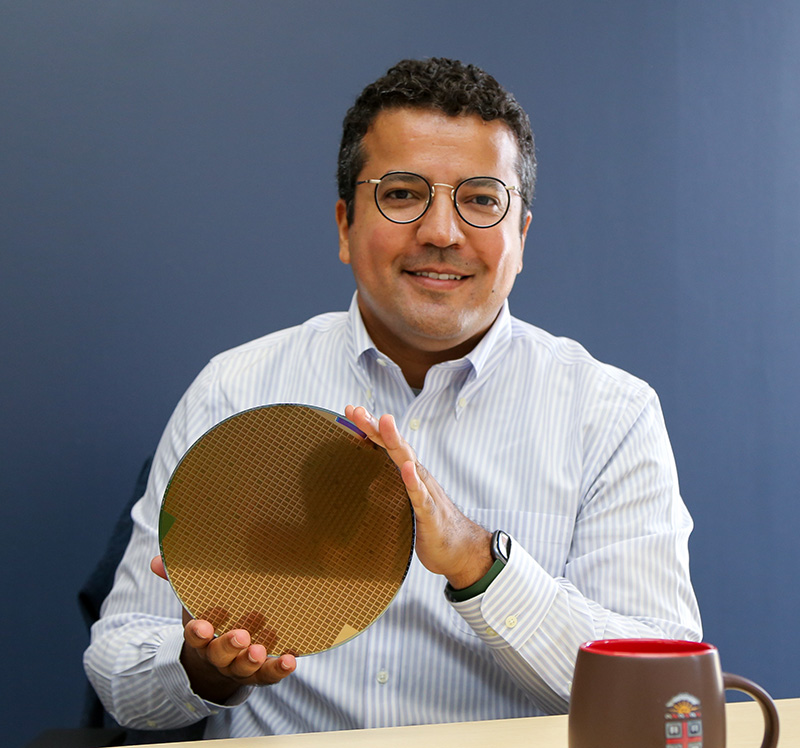
 Engineering Assistant Professor Mehdi Saligane is new to the Brown campus, but his focus remains the same as it has been throughout his career, a career which has spanned more than 15 years and made him a pioneer in the open-source chip design community. He creates secure, low-power integrated circuits for applications ranging from lightweight language model accelerators to biosensors for DNA sequencing, and more things in between.
Saligane is situated in the electrical and computer engineering cluster at Brown, and also serves as Visiting Faculty Researcher at Google Research. He received his Ph.D. from the University of Aix-Marseille and previously held research roles at STMicroelectronics, UC San Diego, and the University of Michigan. He joined Brown in July 2025, after 11 years in Ann Arbor. “I don't feel quite young anymore, although here I’m considered a young professor,” he said, smiling. “At Michigan, I built a group there and still co-advise several students — about four Ph.D. students and a postdoc. I was inspired by professors at Michigan and elsewhere, and I’ve always had great respect for the role. That’s why I wanted to become a professor.”
Saligane says the opportunity to learn alongside his students is one of the most rewarding parts of the job. “Every topic we tackle is different. Whether it’s quantum or bioelectronics, I’m always learning, and I really enjoy that. When you see a student come in during their first year and then a few years later, you can see their trajectory and evolution – that’s incredibly rewarding.”
Saligane was among the first researchers to fabricate a successful chip as part of Google’s open multi-project wafer program in 2021. “Remember back in the ’90s, you might have had a Macintosh or an IBM, but software would work in one and not in the other? The reason that was fixed is by open sourcing software, so that people could contribute to the operating systems and build apps, and so on. Right now, hardware is going through that transition.”
It has been about five years since that movement to make chip design more accessible by providing open-source process design kits, electronic design automation (EDA) tools, and building blocks was initiated. Chips developed from these design kits were invited to be fabricated at no cost to the developer, thanks to a cooperative research agreement between the U.S. Department of Commerce’s National Institute of Standards and Technology (NIST) and Google. Early research partners contributing to those chip designs included Saligane at the University of Michigan, Professor Alex Zaslavsky and Senior Research Engineer Bill Patterson from Brown, the University of Maryland, George Washington University, and Carnegie Mellon University.
Since then, Saligane’s relationship with Google has grown. “They were very happy with the work, and that helped me build my research group at Michigan,” he said. “From there, we started collaborating on other complementary areas. What I like about open-source hardware is that it still involves core circuit design, but it brings a different mindset. You can integrate ideas from artificial intelligence, bioelectronics, and software-driven design methodologies.”
Saligane believes that artificial intelligence and open chip design are mutually reinforcing. “Open design ecosystems generate large amounts of data and reusable components, which are ideal for training AI systems,” he said. “At the same time, AI can dramatically accelerate how we explore circuit architectures and design spaces. I’m particularly interested in bringing more software and AI thinking into hardware design to explore unconventional circuits and improve efficiency.” He added that his work in these areas has been shaped by both collaborations with partners at Google and his own research interests.
He was named a 2023 Google Cloud Research Innovator, after earning a Google Research Faculty Award in 2021. Saligane chaired the analog working group at CHIPS Alliance, and co-founded the Institute for Electrical and Electronics Engineers’ (IEEE) Solid-State Circuits Society (SSCS) Chipathon and Code-a-Chip competitions. He is a founding member of the OpenROAD team, a project to reduce the barriers of access and tool costs to democratize system and product innovation in silicon. He currently chairs the IEEE SSCS Open-Source Ecosystem Technical Committee.
All these awards and service assignments tie him back to his work.
“IC design would be what goes into your phone or wearables, for example,” he said. “And the pedigree of the group I’m coming from is basically making these chips as energy efficient as possible, or extending the battery lifetime. That’s traditionally what I’ve been doing, working on adaptive circuits that make it a little more intelligent, in terms of the way it’s using the power from the battery.” And in an industry where AI is touching almost every aspect of our lives, it makes sense that the next generation of EDA tools will use artificial intelligence to offer deeper insights, predictive analytics and self-optimization capabilities.
“There’s a fundamental change happening right now with AI in every field. Some think hardware is lagging because it’s more tied to the physical act of building a chip, while the software just complies. One of the things I’m trying to do is change mentalities in hardware and think outside the box. That’s why I’ve been telling my students to build intuition. They have the foundations of how to build a chip, but I want them to make decisions based on data. We quickly get overwhelmed when we generate thousands or hundreds of thousands of jobs with training and so on with these models, so I don’t want the student to make the decision based on a single data point. I want the data and AI to make those decisions, overseen by the student. We’ve started to look into circuits that look very weird, but they get you better results, and we’re trying to explain why. This is something I’m very excited about. We’re trying to change the mindset – not just different for being different, but pushing the limit of how we do affordable design. That’s one thing I’m really spending a lot of time on these days.
“I also work on hardware security, which is becoming increasingly important as AI spreads into many edge systems,” he said. “People are already asking how we can trust and control these models. Part of my research focuses on hardware roots of trust and security primitives that can fingerprint or watermark AI models at the hardware level. The goal is to create security mechanisms with minimal area and power overhead that can be integrated seamlessly into many types of devices.”
Perhaps Saligane’s newest research direction overlaps with that of Associate Professor Jacob Rosenstein, as the two plan to develop biosensors-on-chip for DNA synthesis and sequencing. “It’s a frontier area right now, and we’re still exploring where it can go, but I’m very excited about it,” he said. “
Saligane’s first classroom teaching at Brown took place in the fall, a tape-out class for graduate students: Low Power VLSI System Design. (A tape-out class is a specialized, hands-on engineering course where students design an integrated circuit and submit the final layout to a foundry for manufacturing.) “This is not very common, but most of the top universities have started doing tape-out classes. We wanted to build a chip within the class, and by the end, we designed two chips,” he said, his pride evident despite acknowledging the growing pains of creating this curriculum.
“Chip design can be very painful. It has a hard time constraint. You have a deadline, and if you don’t meet that deadline, you’re done. And the chip, the wafer, is very expensive, so that’s not something you want to miss. The way we work is a little more intense than in other fields. I mean, I’m sure others are intense as well, but I will tell you this is demanding.”
Because of the high-stakes nature, there is a rigorous selection process for students interested in joining his lab, ensuring those intense demands can be met. But Saligane can point to former students now employed by Apple, Nvidia, and others that prove its worth. He has also been the principal behind the new student club Brown Open Silicon, an opportunity for open-source chip design projects, workshops, fabrication partnerships, and talks from industry and academic experts on campus, with the goal of making silicon design accessible to everyone.
“I’m very excited about the club,” he said. “The students have been incredibly active. They are building a great website, and the group is really motivated. They want Brown to develop a strong footprint in open silicon, and hopefully, within the next couple of years, we’ll see some important milestones, and build a community around it.”